
 2026-05-17
The Trainer as Director: How Guided Simulations Create Real Workplace Change
A training room can start with electric energy and still end in complete disconnection.
The trainer introduces a role-play exercise. Participants are asked to simulate a negotiation, navigate a difficult client conversation, or resolve workplace conflict. Five minutes later, someone is overacting as they belong in a sitcom, another participant is laughing uncontrollably, and the original learning objective has quietly disappeared into the background.
This happens more often than most trainers admit.
The issue rarely comes from a lack of enthusiasm. It comes from a lack of architecture. Too many exercises rely on random improvisation instead of guided training scenarios intentionally engineered to mirror the emotional pressure and decision-making of real professional environments.
A well-designed scenario acts like a flight simulator for human performance. It gives trainees the freedom to fail safely before the stakes become real. They can test reactions, refine judgment, and build confidence without damaging relationships, revenue, or reputation.
That is where meaningful learning begins.
The DNA of a Powerful Training Scenario: The 3C Framework
Great simulations are not built on creativity alone. They are built on psychological precision.
Effective guided training scenarios are designed around three core elements that create immersion, emotional engagement, and behavioral focus.
1. Context: Build the World Before the Conversation Begins
Context is the invisible stage lighting of the exercise. It shapes how participants think, react, and interpret pressure.
- Where is the interaction happening?
- What happened before this moment?
- What is the relationship between the people involved?
A vague setup produces vague behavior. A rich environment produces emotional realism.
Picture the difference between these two openings: “Talk to an angry customer.”
Versus: “It is 6:40 PM on a Thursday. The client has already emailed twice, but has not received a response. The office is understaffed, deadlines are collapsing, and the customer begins the call already frustrated.”
One feels like homework. The other feels real.
The more specific the environment becomes, the faster trainees stop “performing” and start responding instinctively.
2. Challenge: Force the Skill to Show Up
Every strong scenario needs friction.
The challenge is the heartbeat of the simulation, as it creates the tension participants must resolve. More importantly, it should be impossible to navigate successfully without using the target skill being taught.
If the training focuses on negotiation, the scenario must create a genuine gap between both parties.
If the program teaches emotional intelligence, the participant should face resistance, defensiveness, or emotional volatility.
Otherwise, people simply fall back on old habits.
That is the hidden danger of weak simulations. They allow trainees to survive without growth.
A well-designed challenge corners participants in the best possible way. It nudges them toward new behavior until the skill becomes practical instead of theoretical.
3. Constraints: Add the Pressure That Makes Learning Stick
Real workplaces are messy. Training should reflect that.
Constraints are what transform a clean classroom exercise into something emotionally believable.
- Maybe the participant has incomplete information.
- Maybe the conversation must end in five minutes.
- Maybe the counterpart becomes defensive or emotionally reactive halfway through the interaction.
These constraints create cognitive pressure similar to that experienced by professionals in the real world.
And pressure changes everything.
Anyone can communicate effectively when conditions are perfect. The real test happens when emotions spike, time disappears, and uncertainty enters the room.
That is the environment where durable skills are built.

Scriptwriting for Trainers: The Art of Designing Effective Role Cards
Role cards are the operating system behind guided simulations. Without structure, role-play exercises drift into improv comedy. With structure, they become behavioral laboratories. The goal is not to control every sentence. It is to guide the experience without suffocating realism.
1. The Protagonist Card: Give Direction Without Giving the Answer
The trainee’s role card should define objectives, resources, and desired outcomes.
It should never hand them the script.
The participant must still think, adapt, and apply the newly learned concepts independently. That tension is what creates learning transfer.
Good simulations challenge judgment, not memory.
2. The Counterpart Card: Hidden Instructions Create Controlled Resistance
This is where scenario design becomes sophisticated.
The counterpart receives behavioral triggers hidden from the trainee.
For example:
- “Only soften your position if the trainee demonstrates active listening twice.”
- “Show visible frustration when interrupted.”
- “Become more cooperative when empathy is acknowledged.”
These invisible behavioral cues create intentional resistance patterns that steer the interaction toward the targeted learning outcome.
The scenario begins to feel less like classroom theater and more like live human dynamics.
3. The Observer Card: Replace Opinions With Behavioral Evidence
Most feedback inside training rooms is painfully vague.
- “Good job.”
- “You could improve communication.”
- “That felt strong.”
None of these comments helps people grow.
Professional simulations solve this problem by giving observers behavioral scorecards tied directly to learning objectives.
Observers track measurable actions instead of personal impressions.
- Did the trainee ask open-ended questions?
- Did they summarize concerns before responding?
- Did they maintain emotional composure under pressure?
That shift transforms feedback from subjective commentary into actionable insight.
Research by Eduardo Salas on simulation-based learning further confirms that carefully structured training environments significantly improve team performance when behavioral objectives are clearly defined from the beginning.
From Training Wheels to Survival Mode: Matching Scenario Difficulty to Skill Level
Not every trainee should enter the deep end immediately.
Effective scenario design follows a progression model that balances challenge with psychological readiness.
Linear Scenarios: The Safe Sandbox for Beginners
Linear scenarios are ideal for early-stage learners because they follow a single clear path to resolution.
The objective here is not complexity. It is confidence.
Participants learn the foundational sequence of behaviors inside a controlled environment where the risk of failure feels manageable.
Think of it as the driving school parking lot before entering a crowded freeway.
Branching Scenarios: Where Critical Thinking Comes Alive
Advanced learners need ambiguity.
Branching simulations evolve dynamically based on the trainee’s decisions. Every communication choice reshapes the emotional direction of the interaction.
- Aggressive behavior escalates tension.
- Collaborative behavior stabilizes trust.
- Poor listening creates resistance.
- Empathy unlocks cooperation.
At this level, the exercise stops feeling scripted and starts behaving like real life.
This approach strengthens situational awareness, strategic thinking, and adaptive decision-making under pressure.
Research from Ruth Colvin Clark also highlights that aligning simulation complexity with cognitive load dramatically improves long-term retention and real-world recall.
Debriefing: The Moment Learning Becomes Permanent
Here is the uncomfortable truth most trainers overlook:
The scenario itself is only half the experience.
The real learning happens afterward.
Without structured reflection, even the most immersive exercise fades quickly from memory. Participants may remember the activity, but they rarely extract deep behavioral insight from it.
That is why elite training programs treat debriefing as a strategic conversation rather than a casual discussion.
At ICTM’s design labs, facilitators guide participants through layered reflection questions that unpack emotional, behavioral, and professional meaning.
- Emotional Level: “What emotions emerged while facing the challenge?” (to uncover psychological drivers)
- Procedural Level: “Which alternative decisions could have changed the course of the situation?”
- Application Level: “How does this scenario resemble the challenges you may face at work tomorrow?”
Through these layered discussions, simulations evolve from simple role-play activities into transformative learning experiences that remain deeply embedded in the trainee’s memory.
ICTM: Where Trainers Learn to Design Experiences Instead of Delivering Slides
There is a major difference between presenting information and engineering transformation.
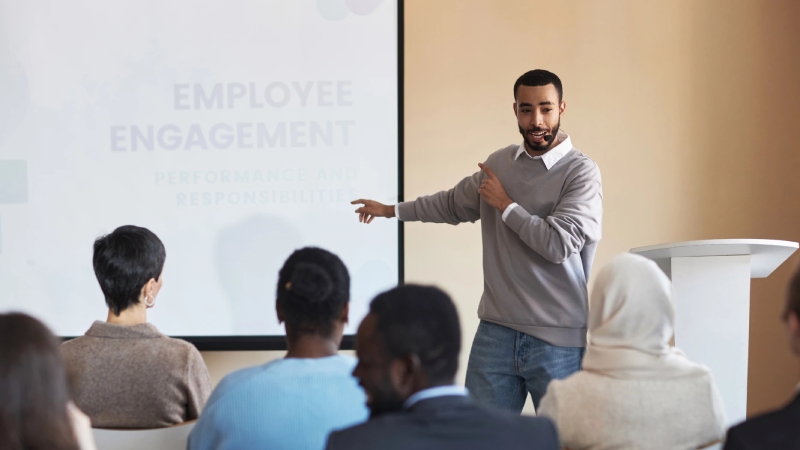
ICTM’s methodology trains professionals to become architects of learning experiences rather than presenters standing beside PowerPoint slides.
Its internationally validated scenario libraries give trainers access to simulation models tested for realism, engagement, and measurable impact.
More importantly, ICTM’s Training of Trainers programs move beyond surface-level presentation skills.
The real emphasis lies in instructional storytelling, behavioral simulation design, and emotionally intelligent facilitation.
Participants learn how to transform dry objectives into immersive professional narratives that place trainees inside the tension of the experience itself.
That shift changes everything.
Because people rarely remember bullet points.
- They remember moments.
- They remember tension.
- They remember how an experience made them feel.
Final Scene: Why Some Training Gets Forgotten While Other Training Changes Careers
Most training disappears the way airport announcements do. People hear it for a moment, then life moves on.
Guided training scenarios yield different outcomes.
They transform learning from passive observation into active emotional participation. They allow professionals to rehearse high-stakes moments before reality demands flawless execution.
And when simulations are designed intentionally, behavior change stops being accidental.
It becomes predictable.
That is the difference between a trainer who fills time and a trainer who shapes professional capability at scale.
The future of training does not belong to the loudest presenter in the room.
It belongs to the designer who can build experiences people carry back into Monday morning.
Want to Build Training Simulations Like a Hollywood Director?
Join a professional ecosystem of experts through ICTM and discover how guided scenario design can transform ordinary workshops into unforgettable learning experiences.
Book a consultation session with a certified ICTM specialist and learn how to turn abstract theories into immersive simulations that reshape professional performance from the inside out.
FAQs
1. Should I write the scenario word-for-word with full dialogue?
No. Strong simulations focus on motivations, objectives, and behavioral direction rather than rigid dialogue. Natural conversation keeps the interaction believable and emotionally authentic.
2. How can I stop trainees from turning the scenario into a comedy performance?
The tone is established before the exercise begins. Realistic scenarios, clearly assigned responsibilities, and observer accountability create a sense of psychological seriousness that keeps participants engaged professionally.
3. What is the difference between a case study and a role-play scenario?
A case study examines a completed situation retrospectively through analysis. A role-play scenario places participants inside a live unfolding moment where emotional and behavioral responses happen in real time.
4. How do I measure the success of a scenario?
Success is measured by behavioral application under pressure, quality of decision-making, and the depth of insight generated during the debriefing process.
This article was prepared by trainer Adel Abbadi, an ICTM certified coach.